These questions were at the centre of the international webinar “Doughnut Economics for Cities and Regions: What Indicators for Maximum Impact?”, held on 21 October 2026 as part of Global Donut Days. Organised by the Doughnut Coalition Hamburg and the Swiss Donut Economics Network, the event brought together European researchers and practitioners to exchange experiences in developing and applying sustainability indicators based on Doughnut Economics.
Among the speakers was Máté Fischer, researcher at GreenFormation and member of the DAISY project team, who presented insights from the Budapest Degrowth Doughnut initiative. Alongside examples from Germany and Switzerland, his contribution highlighted both the opportunities and challenges of translating alternative economic frameworks into practical tools for urban sustainability.
From Sustainability Goals to Meaningful Indicators
Doughnut Economics offers a framework for understanding sustainability through two complementary objectives: ensuring that everyone can meet their essential needs while respecting the ecological limits of the planet.
Applying this framework at the city or regional level requires translating these broad ambitions into locally relevant indicators. Yet selecting the right indicators is far from straightforward.
In his presentation, Oliver Peters from the German Institute of Urban Affairs shared experiences from developing a Data Doughnut for the Rhine County of Neuss in Germany.
The initiative brought together 44 indicators to provide an initial assessment of sustainability across different areas of action. Peters highlighted several methodological challenges, including limited data availability, difficulties in defining meaningful local sustainability thresholds, and the need to balance scientific robustness with political relevance and accessibility.
A central lesson was that indicators inevitably simplify complex realities. Their value therefore depends not only on what they measure, but also on how they are interpreted and used.
The Neuss experience demonstrated that a Doughnut data portrait can serve as a powerful communication and engagement tool. However, turning such an assessment into lasting impact requires connecting it to broader sustainability management processes, including goal-setting, policy development and continuous monitoring.
Measuring What Matters: The Indicator Triangle
Another important perspective came from Camille Gilloots from the University of Lausanne, who introduced the Indicator Triangle, a methodological approach designed to clarify the different roles that indicators play in sustainability assessments.
The framework distinguishes between three interconnected dimensions: the current state of sustainability, the lifestyles and activities driving environmental and social pressures, and the policies or interventions developed in response.
This distinction is particularly important when applying Doughnut Economics.
For example, an indicator describing whether people’s basic needs are being met is conceptually different from one measuring an economic activity intended to satisfy those needs. Treating these indicators as interchangeable may obscure the underlying causes of unsustainability.
Gilloots argued that meaningful indicator frameworks should help practitioners look beyond conventional assumptions about development and economic growth. Rather than focusing exclusively on what can easily be measured, they should encourage reflection on what genuinely contributes to human well-being within ecological boundaries.
In this sense, developing indicators is not merely a technical exercise. It can also become a process of questioning established priorities and encouraging new ways of thinking about sustainability.
The Budapest Degrowth Doughnut: Linking Participation, Indicators and Urban Policy
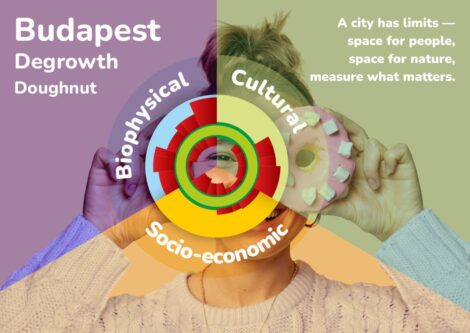
Building on these discussions, Máté Fischer presented the Budapest Degrowth Doughnut, an initiative combining Doughnut Economics with degrowth principles and participatory sustainability assessment.
The Budapest framework emerged from three participatory workshops held in spring 2024, involving 19 local experts from different professional backgrounds. Together, participants developed a set of 23 indicators reflecting the city’s sustainability challenges.
The approach expands the conventional Doughnut framework by considering three interconnected dimensions of sustainability: biophysical, socioeconomic and cultural.
The inclusion of cultural indicators is particularly significant. It recognises that sustainability transitions depend not only on technological solutions, economic conditions or environmental performance, but also on social attitudes, collective practices and broader changes in how people understand well-being and development.
The framework also incorporates locally relevant minimum thresholds and maximum boundaries, reflecting the degrowth perspective that sustainable development must address both unmet social needs and excessive resource use.
Beyond the resulting indicators, Fischer emphasised the importance of the participatory process itself.
Workshops brought together different perspectives to identify relevant indicators, explore connections between sustainability challenges through systems mapping, and develop potential policy responses.
A key achievement was the incorporation of the Budapest Degrowth Doughnut into Budapest’s Climate City Contract in 2024, providing an example of how participatory sustainability research can contribute to formal urban policy processes.
At the same time, the experience revealed several practical challenges, including gaps in locally available data, difficulties in defining appropriate sustainability thresholds, and limited institutional capacity to address complex sustainability issues across traditional policy sectors.
Fischer also highlighted the limitations of Doughnut visualisations. While they can communicate sustainability challenges effectively, they provide only a snapshot of conditions and cannot fully capture the interactions between different indicators. Complementary approaches, such as systems mapping and qualitative analysis, are therefore essential.
Beyond Data: What Makes Sustainability Indicators Transformative?
Despite their different geographical and methodological contexts, the three presentations revealed several shared lessons.
First, data availability remains one of the main obstacles to developing meaningful local sustainability indicators. Municipalities often lack sufficiently detailed information or scientifically established thresholds, making transparent methodological choices essential.
Second, participation is crucial. Involving researchers, policymakers, civil society and other stakeholders can strengthen the relevance and legitimacy of indicators while creating opportunities for shared learning.
Third, visualisation alone is not enough. Doughnut portraits can make sustainability challenges easier to understand, but their potential depends on how they are connected to decision-making, monitoring and concrete policy processes.
Finally, the discussions highlighted that sustainability transformation requires more than technical measurement. Indicators can also challenge conventional assumptions about progress, reveal relationships between social and ecological challenges, and encourage more systemic approaches to urban development.
Taken together, these insights suggest that the most valuable indicators are not necessarily those that are easiest to measure, but those that help communities understand their challenges and identify pathways towards meaningful change.

Connecting the Discussion to DAISY
The experiences shared during the webinar are closely connected to the objectives of the EU-funded DAISY project, which investigates how social, technological and digital innovations can support transformative change for biodiversity and sustainability.
The Budapest Degrowth Doughnut is one of the case studies examined within DAISY. Building on the initiative’s participatory approach and sustainability framework, the project explores opportunities to further integrate biodiversity, ecological restoration and nature connectivity into urban sustainability strategies.
The webinar provided an opportunity to share experiences from this work with an international audience and to learn from complementary approaches developed elsewhere in Europe.
It also reinforced an important message for DAISY’s research: achieving transformative sustainability outcomes requires not only better indicators, but also inclusive processes, systemic understanding and stronger connections between research and policymaking.
By bringing these elements together, approaches such as the Budapest Degrowth Doughnut can help cities move beyond conventional measures of development towards more equitable and ecologically sustainable futures.
Read more about Máté Fischer’s participation in the webinar and the Budapest Degrowth Doughnut initiative in our previous article.