A surprising gap in how “transformation” is used
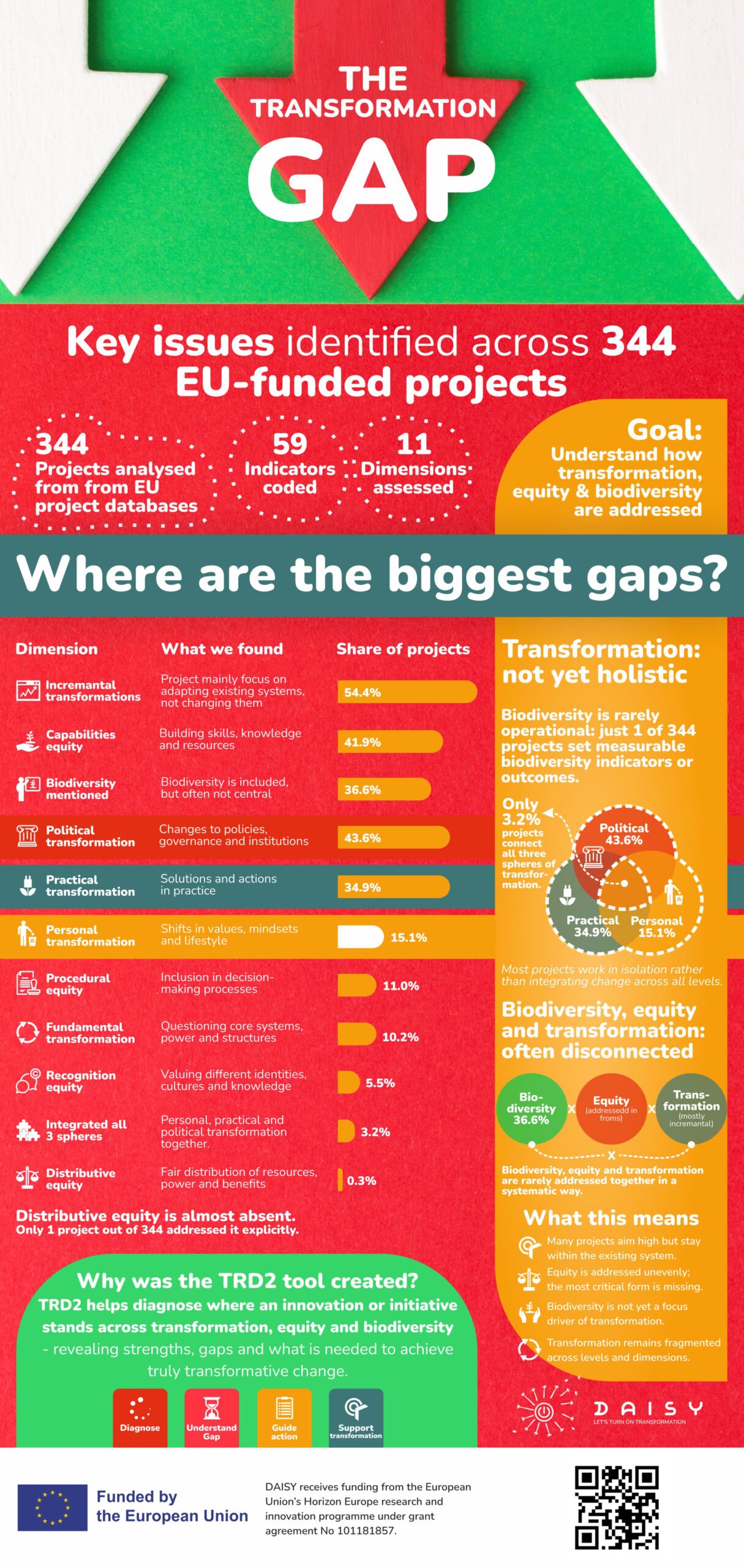
To understand how transformation is currently framed across Europe, DAISY analysed 344 EU-funded projects from 2021 to 2024 that explicitly claimed to address societal transformation. The results were sobering. More than half (54%) described transformation as incremental improvement rather than systemic change, while only 10% addressed genuinely structural transformation. Just 3.2% engaged simultaneously with the personal, practical and political dimensions of change that DAISY’s research treats as the hallmark of real transformation.
The picture was even weaker when it came to equity and biodiversity. Questions of distributive justice, including who benefits and who bears the costs, appeared in only one of the 344 projects, while links between biodiversity and social justice were largely absent. Only around a third of projects (36.6%) explicitly addressed biodiversity at all, with little integration between equity, biodiversity and transformation.
Enter TRD2: a tool built to ask harder questions
These findings directly shaped DAISY’s Transformative Diagnostic Tool (TRD2), a support tool designed to reveal whether an innovation merely improves the status quo or can genuinely contribute to fair, biodiversity-positive transformation.
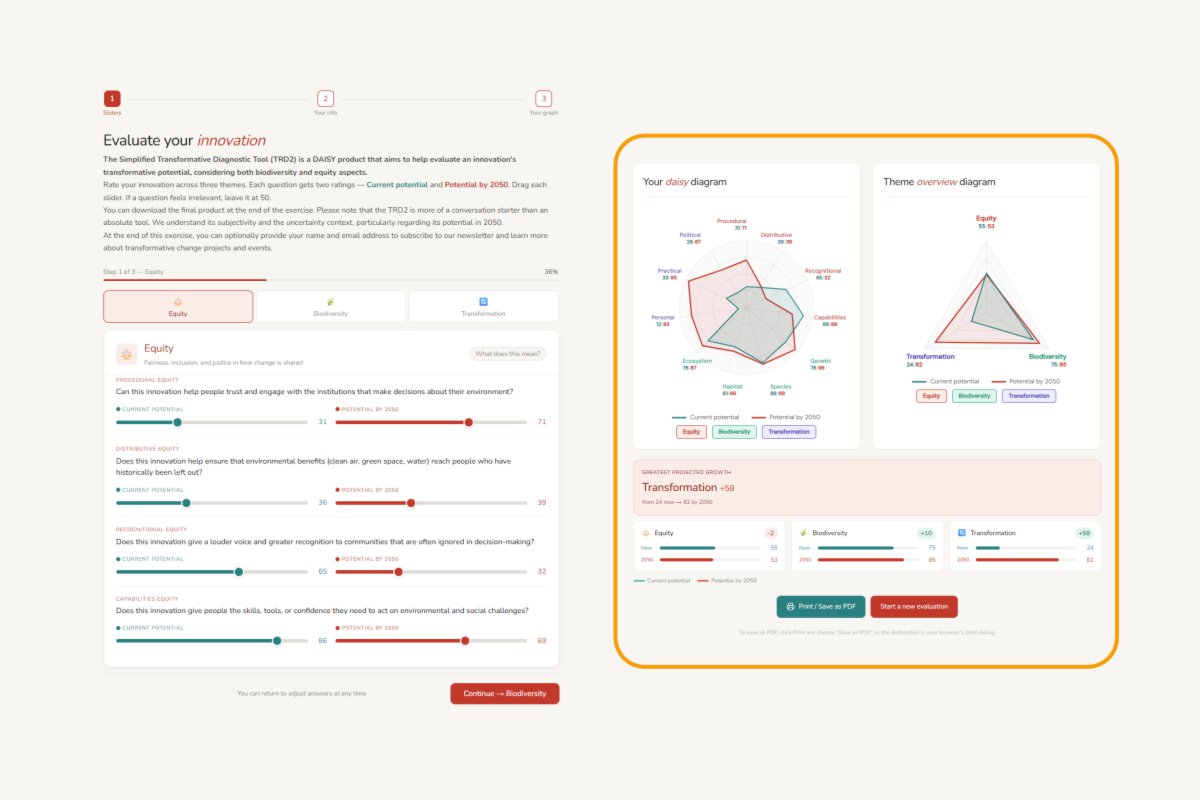
TRD2 evaluates an innovation across three interconnected dimensions:
- Transformation: Does the innovation influence personal change, including values, attitudes and worldviews; practical change, including behaviours, practices and technologies; and political change, including institutions, governance and regulation? In DAISY’s framing, genuine transformation requires progress across all three.
- Equity: Does it advance procedural equity through fair participation in decision-making, distributive equity through the fair sharing of costs and benefits, recognition equity through respect for different identities and knowledge systems, and capabilities equity by strengthening people’s ability to pursue valued ways of life?
- Biodiversity: What effects does it have on genetic, species, habitat and ecosystem diversity?
For each dimension, users assess both the current situation and future potential through to 2050. This produces a structured comparison between where an innovation stands today and how ambitious it could become. Results are visualised as a radar chart. Balanced profiles point to more integrated approaches, while gaps highlight areas where further work is needed.
What has TRD2 found so far?
Through expert workshops, DAISY has already applied TRD2 to a range of innovations spanning traditional practices, governance models, digital technologies and emerging biotechnologies. Several patterns stand out:
- Community-based approaches: Community seedbanks, Indigenous and Community Conserved Areas, and initiatives combining traditional and scientific knowledge consistently scored among the highest for both biodiversity and equity. Their long-term success, however, still depends on supportive governance and equitable benefit-sharing.
- Ecological restoration and land management: Rewilding, agroforestry and organic farming showed strong biodiversity potential but more mixed equity outcomes, particularly in relation to land access and benefit distribution.
- Digital monitoring technologies: eDNA, remote sensing, camera traps and AI-based tools scored well for biodiversity but lower for equity, with experts highlighting unequal access, data ownership and the marginalisation of local knowledge as recurring concerns.
- Governance innovations: Participatory planning, commons-based resource management and Rights of Nature approaches performed relatively well across both dimensions when supported by inclusive representation and long-term investment.
- Emerging technologies: GM crops, vertical farming and some AI applications produced the most mixed results, with questions around access, ownership and unintended ecological consequences reducing otherwise promising biodiversity benefits.
The headline finding is that none of the innovations assessed so far scored highly across all three dimensions of transformation, equity and biodiversity at once. Transformative potential, it turns out, is not an inherent property of an innovation. It emerges from the way that innovation interacts with governance arrangements, enabling conditions, social context and complementary interventions.
Who is TRD2 for?
TRD2 is designed as a structured reflection and dialogue tool for policymakers, researchers, innovators and civil society organisations that need a practical way to assess whether an innovation is contributing to biodiversity-positive, equitable and genuinely transformative change rather than simply assuming that it is. By making the links between biodiversity, equity and transformation more visible, TRD2 aims to help move projects and policies beyond incremental improvements and towards the systemic changes that the evidence suggests are still largely missing.
TRD2 is freely available on the DAISY project website, and the full research behind it is documented in DAISY’s D1.4 report.