
What makes a city successful?
For decades, urban success has often been associated with growth: more investment, more construction, more consumption and greater economic output.
But what if the more important question were whether a city allows people to live well within ecological limits?
The Budapest Degrowth Doughnut case explores this alternative perspective. Inspired by Doughnut Economics and degrowth, the initiative asks how Budapest’s future could be organised around biodiversity, social equity and long-term liveability rather than treating economic growth as the overriding measure of progress.
About DAISY
 DAISY – DigitAl, technologIcal and Social innovation mixes enabling transformation for biodiversity and equitY – is a Horizon Europe research and innovation project investigating how different forms of innovation can contribute to systemic transformation.
Its approach recognises that biodiversity and equity are closely connected. Environmental policies do not operate in a social vacuum: who participates, who pays, who benefits and who has access to resources all influence whether a sustainability transition is genuinely transformative.
What is DAISY trying to achieve?
DAISY examines the processes that shape our personal, political and practical ability to respond to the biodiversity crisis.
Rather than searching for one universal solution, the project develops and studies intervention mixes: combinations of policy, technology, social innovation, institutional change and behavioural interventions that may reinforce each other.
Budapest provides an especially interesting test because almost every major urban system – housing, mobility, green space, food, water, public finance and citizen participation – potentially intersects with the degrowth doughnut perspective.
A different picture of Budapest
The desired future developed around the Budapest case is tangible rather than abstract.
In this desired future, healthy streets and school streets become normal across the city instead of remaining isolated experiments. Community and neighbourhood gardens form connected green networks. Walking and cycling become safer and easier, while affordable public transport reduces dependence on cars.
Public spaces and schoolyards provide shade, vegetation and habitat rather than being dominated by asphalt. Urban waters recover and green spaces become more ecologically diverse.
But the social side of the Budapest Degrowth Doughnut is just as important.
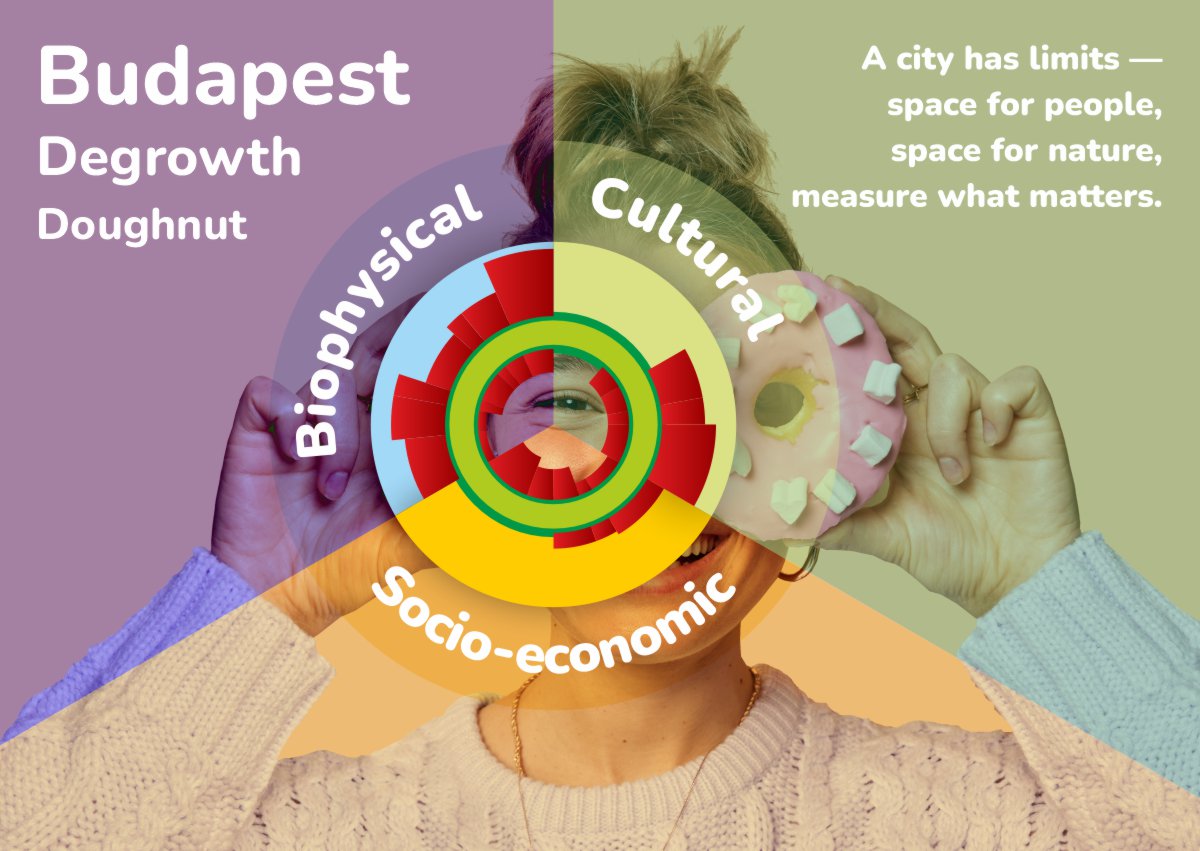
Affordable housing, clean air, healthcare, education, mobility and culture are understood as basic elements of urban wellbeing. Residents have meaningful opportunities to participate in decisions, and the costs and benefits of environmental transition are shared more fairly.
The desired Budapest is therefore not simply greener. It is simultaneously greener, healthier, more accessible and more democratic.
No single policy can build this city
The transformative interventions discussed around the case span almost every area of urban governance.
Zero-waste initiatives and energy efficiency can reduce resource use. Sponge-city approaches and biodiversity restoration can improve ecological resilience. Housing regulation and expansion of environmentally renovated municipal housing can address affordability. Walking, cycling and public transport can reshape mobility.
Fiscal measures can also contribute to fairness, while green public procurement can direct municipal spending towards socially and environmentally aligned providers.
Participation is another part of the mix: community budgets, neighbourhood spaces and stronger civil-society involvement can give residents greater influence over the transition.
Digital technologies could contribute too. A digital twin of Budapest, for example, could help policymakers understand how interventions in one part of the urban system affect another.
Yet this comes with an important warning.
A technologically optimised city is not necessarily a transformed city. If digital tools merely make a resource-intensive and unequal urban system more efficient, they may help preserve the very structures that need to change.
The Budapest case therefore brings DAISY’s central question into sharp focus: are we making the existing system greener, or are we changing what the system is designed to achieve?
A degrowth doughnut-inspired Budapest points towards the latter – a city where ecological limits and social wellbeing become the starting point for decisions rather than constraints considered afterwards.

