
DAISY’s second consortium meeting brought together 18 partner organisations from Hungary, Germany, Greece, the United Kingdom, and the Netherlands in Budapest from 24–26 March 2026. The three-day event combined intensive working sessions with an urban field visit, offering both strategic reflection and hands-on learning in one of Budapest’s inner districts.
Hosted at Impact Hub Budapest, researchers from diverse disciplines reviewed progress across the project, revisited key insights from the initial work packages, and deepened cross-case learning on how “seed innovations” can catalyse transformative change for biodiversity and equity. Discussions focused on connecting retrospective insights with forward-looking experimentation, particularly through the lens of the transformative intervention mixes framework. Concrete pathways for amplifying promising innovations and extending their systemic impacts across different societal spheres were also discussed.
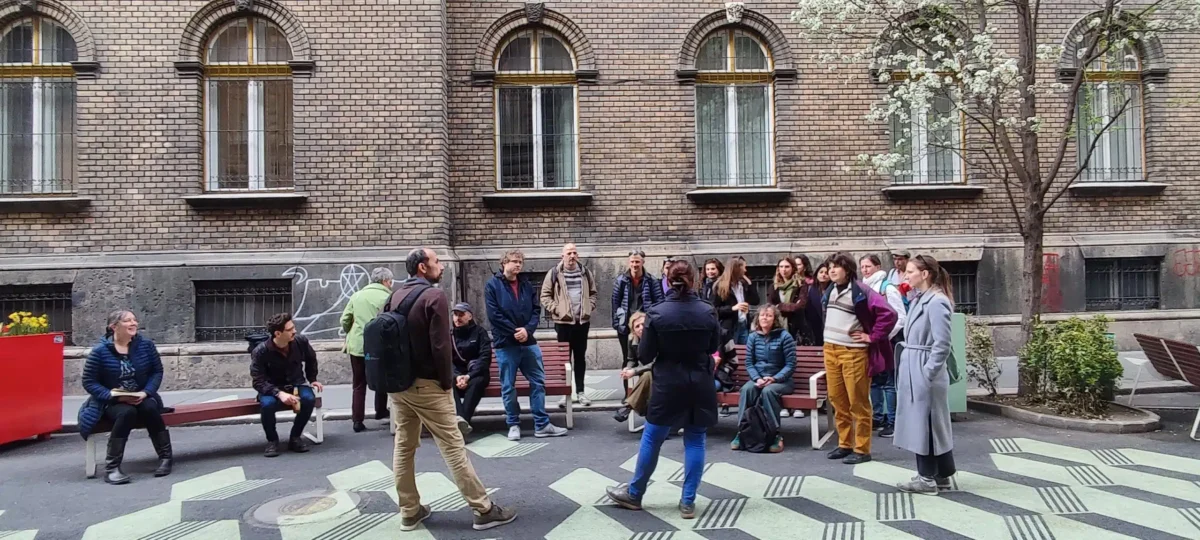
A key highlight of the meeting was a half-day urban walk linked to the Budapest Degrowth Doughnut seed innovation, one of DAISY’s five case studies. Travelling from the city centre into Józsefváros, participants visited several pioneering sites: the “school street” on Trefort utca, the redesigned “healthy street” on Déri Miksa utca, and the Német József “neighbouring garden.” The tour was guided by experts from Corvinus University, the Municipality of Budapest, the city’s public transport company (BKK), and local garden managers. They shared first-hand insights into how urban spaces have been reshaped to prioritise children’s safety, walkability, greenery, and biodiversity. The day concluded with a reflection session back at Impact Hub Budapest, where partners discussed how these local examples could inspire similar initiatives across DAISY’s case studies throughout Europe.
The Budapest Degrowth Doughnut serves as a powerful visualisation tool, mapping the city’s ecological boundaries alongside its social foundations. It makes complex sustainability challenges more accessible to both citizens and policymakers, while also revealing the interconnected drivers of biodiversity loss. Through its collaboration with the Municipality of Budapest, DAISY contributes tools for monitoring biodiversity-related indicators, identifying necessary interventions, and co-developing transformative policy recommendations.
As Budapest begins embedding the doughnut framework into its Biodiversity Strategy and broader municipal policies, the initiative stands as a replicable model for other cities and districts. It demonstrates the value of participatory, adaptable approaches to achieving socially just and ecologically sustainable urban transformation.
Across all five of its case studies, DAISY continues to advance innovative approaches that support both biodiversity and equity in diverse contexts, and amplify change through scales and sectors.

